How to start reading the Bible when you feel overwhelmed
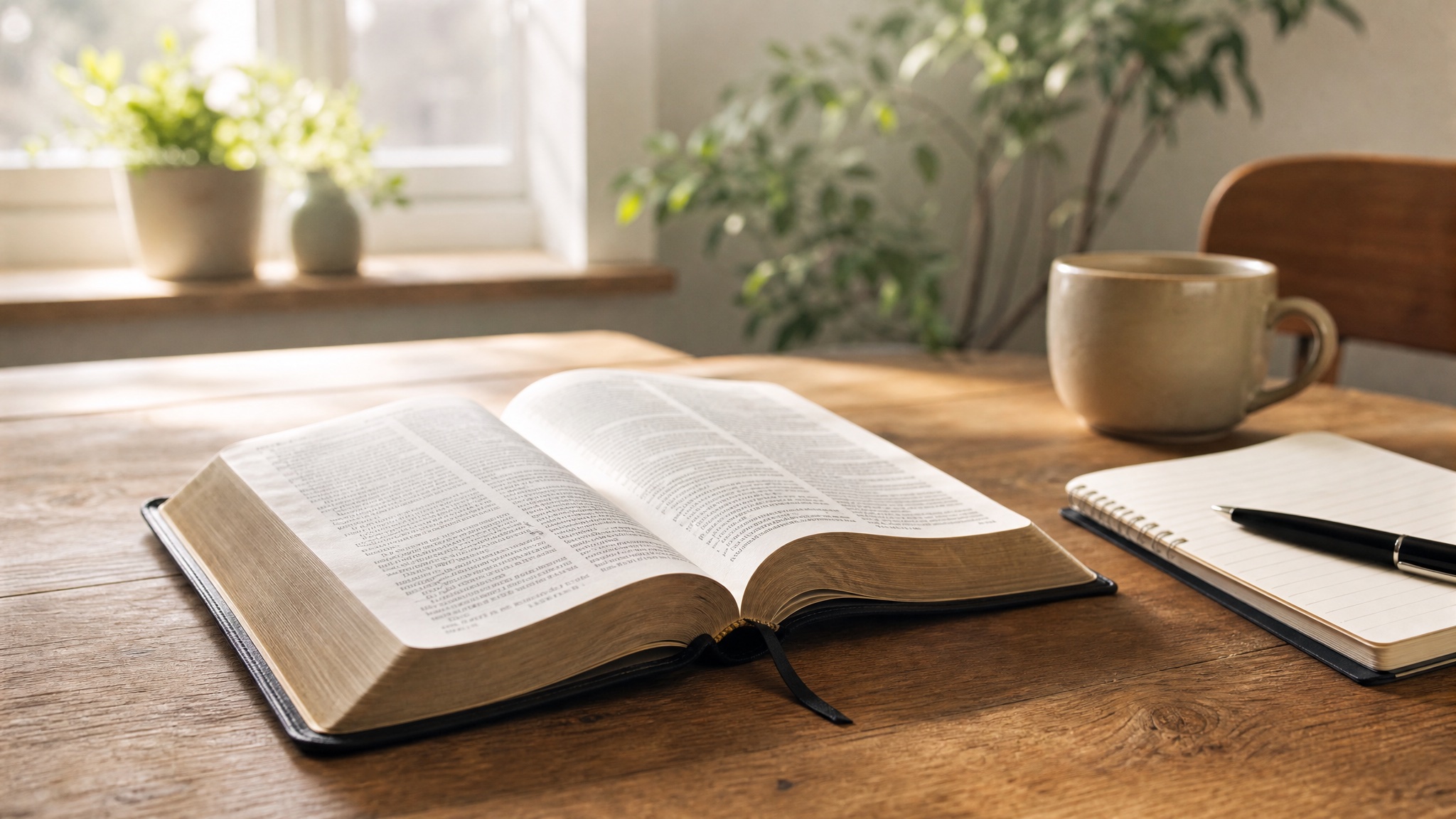
You want to read the Bible. That part is clear. But you opened it, saw 66 books and over a thousand chapters, and thought: Where do I even start?
You’re not alone. That feeling of being overwhelmed is probably the single biggest reason people put the Bible back on the shelf. Not because they don’t care, but because nobody gave them a simple way in.
This guide is for you. We’ll walk through exactly where to start, which translation to pick, and how to turn Bible reading into a daily habit you actually keep. You don’t need a theology degree, and nobody’s going to ask you to read it all in a year. Just a clear path from “I don’t know where to begin” to reading one chapter a day with confidence.
Table of contents
- Why the Bible feels overwhelming (and why that’s normal)
- Where to start reading: the best books for beginners
- Which Bible translation should you use?
- How to build a daily Bible reading habit
- A simple 30-day reading plan to get you started
- Common mistakes beginners make (and how to avoid them)
- Tools that make Bible reading easier
- FAQ
Why the Bible feels overwhelming (and why that’s normal)
Here’s the thing most people don’t realise: the Bible isn’t one book. It’s a library. Sixty-six books written across roughly 1,500 years by dozens of different authors in three languages. It contains history, poetry, letters, prophecy, and narrative. Some parts read like a novel. Others read like ancient legal code.
So if you picked it up and felt lost, that’s a completely rational response. You were trying to read an entire library in one sitting.
The good news? You don’t need to understand all of it to start. You don’t need to begin at page one. And you definitely don’t need to read it cover to cover on your first attempt. Most experienced Christians haven’t done that either.
What you need is a starting point, a translation you can understand, and a small daily habit. Let’s work through each one.
Where to start reading: the best books for beginners
The most common advice is to start with the Gospel of John, and it’s good advice for a reason. John tells the story of Jesus in a way that feels personal and easy to follow. It’s 21 chapters long, which means you could read one chapter a day and finish in three weeks.
But John isn’t the only option. The best starting point depends on what you’re drawn to.
If you want to meet Jesus first, start with the Gospel of Mark. At only 16 chapters, it’s the shortest Gospel and the most fast-paced. Mark doesn’t waste time with genealogies or long sermons. He jumps straight into what Jesus did, one scene after another. You can finish it in two weeks reading one chapter a day.
If you want practical life wisdom, start with Proverbs. It’s 31 chapters of short, direct insights about relationships, money, work, and character. One chapter per day maps perfectly to a calendar month. The writing style is different from narrative books, but many beginners find it immediately useful.
If you want the big story from the beginning, start with Genesis. It covers creation, the first families, Abraham, Joseph, and the origins of the nation of Israel. Genesis reads like a sweeping drama with real characters making real choices. Fair warning: it’s 50 chapters, so it’s a longer commitment than Mark or John.
If you want encouragement and comfort, start with Psalms. These are songs and prayers written by people going through everything from joy to grief to anger. They don’t follow a story. You can open to any psalm and find something that resonates with what you’re feeling today.
Here’s a quick comparison to help you choose:
| Book | Chapters | Best for | Time to read (1 chapter/day) |
|---|---|---|---|
| Mark | 16 | Meeting Jesus quickly | ~2 weeks |
| John | 21 | Understanding who Jesus is | ~3 weeks |
| Proverbs | 31 | Daily practical wisdom | ~1 month |
| Genesis | 50 | The origin story | ~7 weeks |
| Psalms | 150 | Prayer and comfort | Dip in anywhere |
Our suggestion: if you’ve never read the Bible before, start with Mark. It’s short, it’s engaging, and it gives you the core story of Jesus without needing any background knowledge. After Mark, move to John for a deeper look, then branch out from there.
Which Bible translation should you use?
The Bible was originally written in Hebrew, Aramaic, and Greek. Since most of us don’t read ancient languages, translations do the work of bringing those words into modern English. But not all translations work the same way.
Some prioritise matching the original words as closely as possible (word-for-word). Others focus on communicating the original meaning in natural English (thought-for-thought). Neither approach is wrong. They just serve different purposes.
For beginners, we recommend starting with a thought-for-thought or balanced translation. Here’s why: the point of reading the Bible for the first time is to understand what you’re reading. You can always move to a more literal translation later once you’re familiar with the content.
Best translations for beginners:
The New Living Translation (NLT) reads almost like a conversation. It’s the easiest major translation to understand while still being faithful to the original text. If you’ve never read the Bible, this is a great first choice.
The New International Version (NIV) strikes a balance between readability and precision. It’s the most widely used modern English translation, which means you’ll find plenty of study resources built around it. According to Church Answers, the NIV consistently ranks as the bestselling modern English Bible translation by volume.
The English Standard Version (ESV) leans more toward word-for-word accuracy. It’s slightly more formal than the NLT or NIV, but still very readable. Many churches use the ESV for teaching and study.
Translations to save for later:
The King James Version (KJV) is beautiful and historically important. The Museum of the Bible notes it has shaped English literature for over 400 years. But the 17th-century language (“thou,” “hath,” “wherefore”) makes it harder to follow as a beginner. Come back to it once you’re more familiar with the content.
The New American Standard Bible (NASB) is extremely precise but reads more like a textbook than a story. It’s excellent for detailed study once you have context for what you’re reading.
A quick note: you don’t have to buy a physical Bible to start. Free Bible apps and websites like BibleGateway.com let you read any translation instantly. Pick one translation and stick with it for your first book. Switching between translations mid-read tends to create confusion, not clarity.
How to build a daily Bible reading habit
Reading the Bible isn’t hard. Reading it consistently is. And consistency matters more than volume. Reading one chapter a day for six months will shape you far more than reading ten chapters once and then stopping.
A few things that actually help:
Start ridiculously small
One chapter. That’s your target. Most Bible chapters take five to ten minutes to read. If ten minutes feels like too much, read half a chapter. The goal for the first few weeks isn’t to cover ground. It’s to build the muscle of showing up every day.
Research from the European Journal of Social Psychology found that forming a new habit takes an average of 66 days, with easier habits forming faster. Reading one short chapter is easy enough to become automatic.
Attach it to something you already do
Habits stick better when they’re tied to an existing routine. Read your chapter right after your morning coffee. Read it on the train to work. Read it in bed before you fall asleep. The specific time matters less than the consistency of the trigger.
James Clear, author of Atomic Habits, calls this “habit stacking”: pairing a new behaviour with an established one so you don’t have to rely on motivation alone.
Pick the same time and place
Your brain builds associations between behaviour and environment. When you sit in the same spot at the same time with your Bible open, your brain starts to expect it. After a few weeks, it stops feeling like effort and starts feeling like routine.
Don’t try to understand everything
This trips up more beginners than anything else. You’ll hit passages that confuse you. Names you can’t pronounce. Cultural references that don’t make sense. That’s fine. Don’t stop reading to research every question. Just keep going. Mark what confuses you and come back to it later. Understanding grows with repeated reading, not with perfect comprehension on the first pass.
Track your progress
There’s something satisfying about checking off a box. Whether it’s a reading plan in an app, a notebook, or a wall calendar, tracking your streak gives you a small reward each day. Manna is a free Bible reading app built around this idea: one chapter a day, with a simple tracker that shows your streak and progress through each book.
A simple 30-day reading plan to get you started
If you want a concrete plan rather than a vague “just start reading,” here’s one. This plan takes you through Mark in two weeks, then into John. You’ll meet Jesus through two different perspectives, which gives you a solid foundation for reading anything else in the Bible.
Week 1-2: The Gospel of Mark Read one chapter per day, Mark 1 through Mark 16. Mark moves fast, so each chapter covers a lot of ground. Pay attention to what Jesus does and how people respond to him.
Week 3-4: The Gospel of John (chapters 1-14) John is more reflective than Mark. Where Mark shows you what happened, John tells you what it means. Read one chapter per day. Don’t rush. Some of these chapters contain ideas that people have spent their entire lives thinking about.
After 30 days, you’ll have read two complete perspectives on the life of Jesus. From there, you could continue with John 15-21, move on to Genesis for the big origin story, or try Psalms for daily prayers and songs.
The key is to finish something. Completing one book feels like momentum. Abandoning five books halfway through feels like failure. Start small, finish what you start, then expand.
Common mistakes beginners make (and how to avoid them)
After talking with hundreds of people who have tried and failed to build a Bible reading habit, these are the patterns that show up again and again.
The most common one is jumping straight into a “read the whole Bible in a year” plan. These plans often require three or four chapters a day, which works out to roughly 30-45 minutes of reading. For someone who isn’t in the habit yet, that’s a recipe for burnout. You fall behind in week two, feel guilty, and quit. Start with one chapter. You can always scale up once the habit is solid.
Another frequent stumbling block is beginning with the Old Testament and getting stuck in Leviticus. Genesis is interesting. Exodus starts well. Then you hit Leviticus, which is largely ceremonial law about sacrifices and cleanliness rituals. It’s an important book, but it’s not where beginners should start. This is why we recommend a Gospel first. Come back to the Old Testament once you have context for the bigger story.
Equally problematic is reading without any plan at all. Opening the Bible to a random page and hoping for the best usually leads to frustration. You might land in the middle of a genealogy in 1 Chronicles or a prophecy in Ezekiel that requires significant background knowledge. Pick a book, start at chapter one, and read through it in order.
Then there’s the comparison trap. Some people in your church or community might read the Bible for an hour each day. They might have been doing it for 30 years. Comparing your week-two reading habit to their decades of practice is like comparing your first jog to a marathon runner’s training session. You’re at the start. That’s exactly where you should be.
Finally, try not to treat it like homework. The Bible isn’t an assignment you have to power through. If you hit a passage that excites you, stay there for a while. If something confuses you, it’s fine to skip it and come back. Read at your own pace. This is supposed to be a relationship with God, not a task on your to-do list.
Tools that make Bible reading easier
You don’t need much to start reading the Bible. A phone and a free app will do. But a few tools can make the experience smoother, especially for beginners who benefit from structure.
Bible apps put every translation in your pocket and let you switch between them instantly. Many include reading plans, bookmarks, and highlighting. Manna takes a different approach: instead of giving you dozens of features, it focuses on one thing: reading one chapter a day. It tracks your streak, shows your progress, and keeps things simple. If you’re the type of person who gets overwhelmed by too many options, that simplicity can be the difference between reading and not reading.
Study Bibles include notes and explanations alongside the text. The ESV Study Bible and the NIV Life Application Study Bible are both solid choices. Study notes help when you hit confusing passages, but they can also slow you down. Our advice: read through a book once without study notes, then go back with a study Bible for deeper understanding.
A journal or notebook for writing down what stands out. This doesn’t need to be formal. Even a single sentence like “Jesus healed people who everyone else ignored” is worth writing down. The act of writing helps you process what you’ve read and gives you something to reflect on later.
A reading partner or small group. Reading the Bible with someone else creates accountability and lets you discuss what you’re learning. If you attend a church, ask about small groups or Bible studies for beginners. If you don’t attend a church, a friend who’s also interested in starting can fill the same role.
FAQ
What is the best book of the Bible to read first?
For most beginners, the Gospel of Mark is the best starting point. It’s 16 chapters, moves quickly, and tells the story of Jesus without requiring background knowledge. If you prefer something longer and more reflective, the Gospel of John is another excellent first read. Both give you the foundation you need to understand the rest of the Bible.
Do I have to read the Bible from beginning to end?
No. The Bible isn’t designed to be read like a novel from page one to the last page. It’s a collection of books, and you can start with whichever one best fits where you are. Most pastors and Bible teachers, including resources like Bible Project, recommend starting with one of the four Gospels (Matthew, Mark, Luke, or John) rather than Genesis, because understanding Jesus gives you context for everything else.
How long should I read the Bible each day?
Start with 10-15 minutes, which is roughly one chapter for most books. That’s enough to build a consistent habit without overwhelming your schedule. As reading becomes part of your routine, you may naturally want to spend more time. But 10 minutes of daily reading will always beat 60 minutes once a week.
Which Bible translation is easiest to understand?
The New Living Translation (NLT) is generally considered the easiest modern English translation to read. It uses everyday language while staying faithful to the original text. The New International Version (NIV) is another good option that balances readability with accuracy. Both are widely available in print and digital formats.
What if I don’t understand what I’m reading?
That’s completely normal, and it happens to experienced readers too. Don’t let confusion stop you from reading. Keep going, and the parts you don’t understand will often make more sense as you read more of the Bible. For specific questions, a study Bible or a free resource like GotQuestions.org can help fill in the gaps. You can also bring your questions to a pastor, a small group, or a trusted friend who reads the Bible regularly.
Ready to start? Manna is a free Bible reading app for iOS that gives you one chapter a day and tracks your streak. Nothing complicated. Just you and the Bible, one chapter at a time.